HIFU vs RF for Your Face: At-Home Beauty Devices Explained (Part 1)
Translated from Calarygirl She’s one of the beauty YouTubers I personally enjoy watching. She’s very knowledgeable about beauty and tends to put out detailed, high-quality reviews regardless of sponsorships. If you have some time, her channel might be worth checking out. Original Title: Beauty Device Beginner's Guide Complete Newcomers Welcome
Video: https://www.youtube.com/watch?v=wpPiBTYC8FA
[Reading Note]
- This video includes paid promotion for LG Pra.L. I still chose it because the creator appears to have reviewed nearly every product available in Korea fairly, including in earlier videos with no advertising.
- I smoothed out overly fragmented speech so it reads naturally. Example: “It's like when a squid gets heated and shrinks up, and then your skin shrinks and you get the effect you want.” → “Like a squid curling up when it is heated.”
- I reordered parts that jumped back and forth so they are easier to follow. Example: Original: A → B → A → B. Revised: A → A → B → B.
- Prices, discontinuation status, effect descriptions, and event details reflect what was said when the video was recorded.
- A few expressions or English-style product names may contain mistranslations.
My Complete Take on 46 Beauty Devices

46 Beauty Devices 00:00–01:07
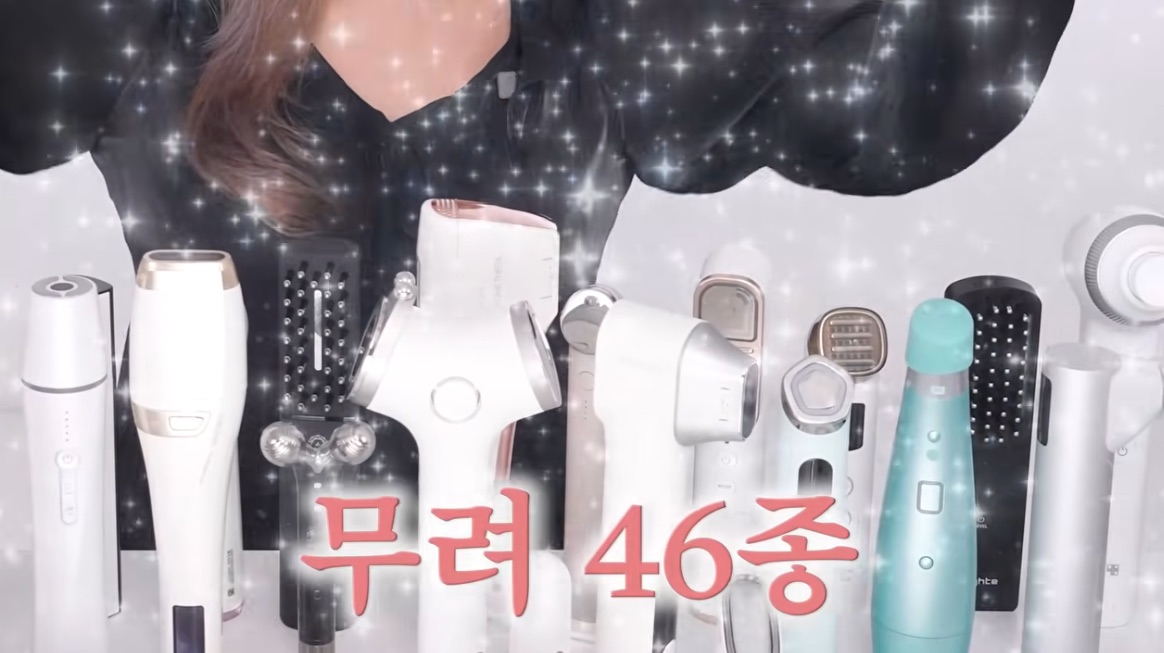
Buying a device can easily cost several hundred thousand won. I had originally planned to round up only HIFU devices, but then I thought about it: a lot of people are not even at the “Which HIFU should I buy?” stage yet. If you are stuck at “So what actually suits me?”, let me draw you a beginner's map first. I have 46 facial devices laid out here. That is facial devices only; I left out the body devices. Rather than spending big on one technology right away, I think beginners are better off starting with a multi-device that combines several functions. There are three things to look at: what technology is inside, how you would actually use it, and whether it is easy to use. You have to use it often to get your money's worth, after all. I will go through seven technologies, roughly from higher to lower price points, then wrap up with how to choose a multi-device.
HIFU 01:07–03:42

HIFU, or high-intensity focused ultrasound, is easiest to understand if you think of Ultherapy or Shurink. It sends energy to a point roughly 3–4.5 mm below the skin. Like a squid curling up when it gets heated, it is used to tighten and refine a loose facial contour, such as a double chin or jowls. Home devices can sting too. To me, it feels a bit like being tapped with a chestnut burr. The ones I own include homethera, Dualsonic, Rejureaf, Medicube AGE-R High Focus Shot, Dermathera, and d’Alba. A lot of these devices cost around KRW 1 million, and some are even sold on rental plans like water purifiers. But do not look only at the device price. Check whether it works without replacement cartridges, like Medicube, whether cartridges cost hundreds of thousands of won to replace, and whether separate cartridges are needed for each treatment depth in millimeters. And here is the really important question: how many more years are they going to keep selling those cartridges? Dermathera was one of my favorites not because it reached the deepest, but because it was so easy that I used it the most. No matter how good something is, it is useless if you never use it. Then the device was discontinued, and cartridge sales stopped too. Once I use up the one currently installed, a KRW 1 million machine turns into a brick.
RF 03:42–06:55

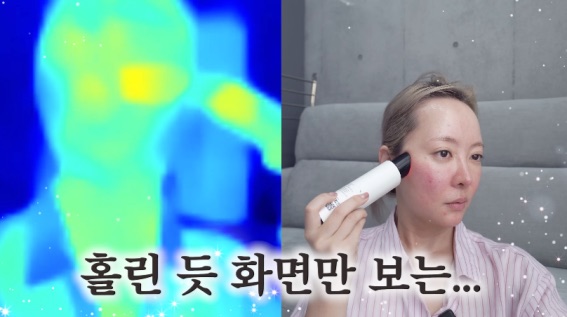
The next expensive technology is RF, or radiofrequency. Think of it as a technology that generates heat under the skin through rapid oscillation. While HIFU is more about pulling up the facial contour, RF feels closer to making the eye area or nasolabial folds look a little plumper and supporting the skin’s overall baseline condition. In-clinic, think Thermage. I felt that RF care helped me after under-eye fat surgery. I also like how my redness-prone face looks clearer the next morning after I use it. Your face can look red immediately afterward because of the heat, but home RF feels more like a warm hot-water pack than pain. That said, when I compared devices with a thermal camera, quite a few did not seem to raise the temperature properly. Of course, the camera only reads the surface, while the devices talk about a deeper 40–43°C, so the two are not identical. Still, if it cannot warm the surface well, did it really heat deeper tissue properly? I keep wondering. Just seeing a technology name on the product page is not enough. There are devices such as Ultra Tune, Rejureaf, Dualsonic Alto, and Volium, which I like. Japanese devices can do RF well too, but one costs KRW 1.6 million, another KRW 500,000, and you have to import them directly. This is a category where KRW 500,000–1 million is common. Yes, it is expensive.
LDM 06:55–09:18

Next is ultrasound for product delivery: the devices called LDM in the video. LDM means Local Dynamic Micromassage. It also uses vibration, but unlike RF, it is aimed at helping skincare on the surface make its way in. Think of a dolphin going “waa-waa” with ultrasound. The expected benefit is not a dramatic lift but more about dryness, hydration, and glow. When skin holds water well, fine lines and pores tend to stand out less too. I think it is a nice device to have. It is generally presented as a relatively gentle technology, and many products say it can be used daily. The “cheaper than one cup of coffee a day” pitch makes sense if you really use it every day. But why have these gotten so expensive lately? They are now up in the KRW 500,000–1 million range. I barely feel any discomfort. Sometimes I am using one and wondering whether it is even working. We are not dolphins, so we cannot really feel ultrasound. I own TOM The Glow, Quadthera, Quadthera Mini, and Injectier, and I have another video comparing them one by one. Let me talk about discontinued devices a little more. My favorite was the LG Pra.L Skin Booster. It was the device I would pull out immediately on mornings when I needed to put on makeup but my skin was not looking great. It cost around KRW 200,000–300,000, was easy to use, and combined ultrasound delivery with microcurrent. After five minutes, my redness seemed to calm down and my face looked clearer. And they discontinued it. The more I think about it, the more annoying it is. (I’ll cover the rest later, including EMS, microcurrent, galvanic current, electroporation, multi-function device recommendations, and her final product picks.)
Preview of Part 2: EMS and microcurrent 09:18–12:42
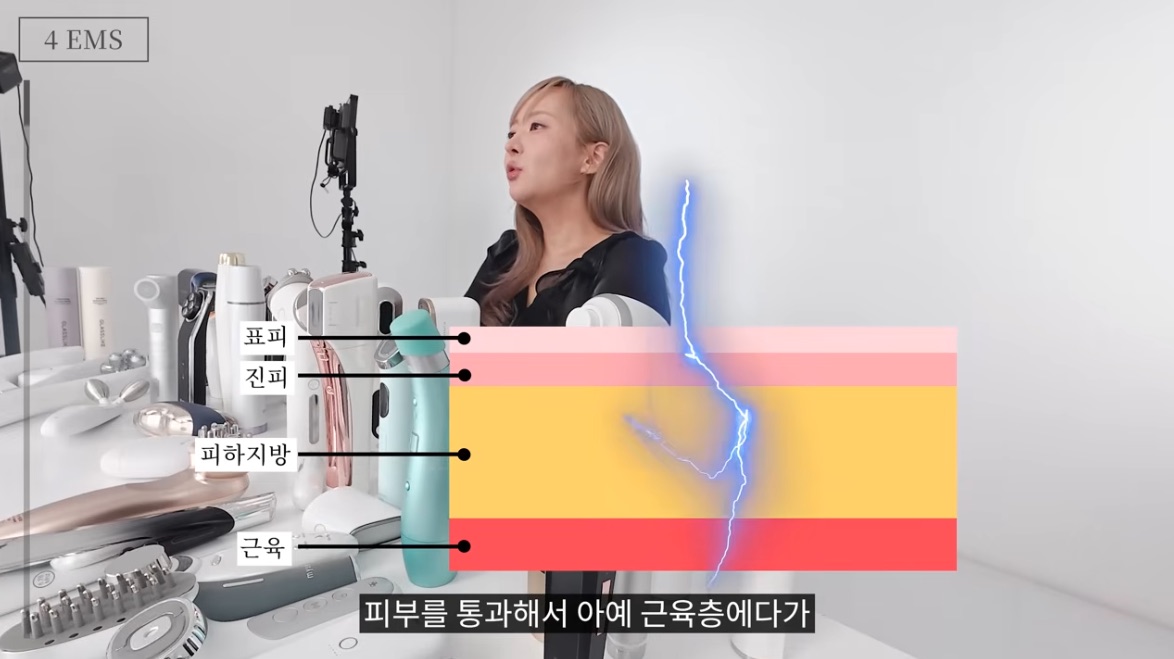
EMS, or electrical muscle stimulation, uses medium- or low-frequency electrical stimulation to prompt muscles to contract and relax. So its goal overlaps a little with HIFU when it comes to facial-contour care. I also feel that EMS massage on my face or scalp calms my redness, and I wonder whether that has something to do with lymphatic circulation.

Continue with Part 2: EMS vs microcurrent, galvanic current and electroporation, then Part 3: the strongest device and the LG Pra.L Superform Thermashot. For a one-page summary, see the HIFU vs RF vs EMS vs microcurrent comparison chart.
Common questions
What is HIFU and how does it feel at home?
HIFU, or high-intensity focused ultrasound, is easiest to understand if you think of Ultherapy or Shurink. It sends energy to a point roughly 3–4.5 mm below the skin and is used to tighten and refine a loose facial contour, such as a double chin or jowls. The YouTuber says home devices can sting, a bit like being tapped with a chestnut burr.
What should I check before buying a HIFU device?
Whether it works without replacement cartridges, whether cartridges cost hundreds of thousands of won to replace, whether separate cartridges are needed for each treatment depth, and how many more years the brand will keep selling them. She says her favorite device was discontinued and its cartridge sales stopped, so a KRW 1 million machine turns into a brick once the installed cartridge is used up.
What does RF do for the face?
RF, or radiofrequency, generates heat under the skin through rapid oscillation. While HIFU is more about pulling up the facial contour, she says RF feels closer to making the eye area or nasolabial folds look plumper and supporting the skin’s overall baseline condition. In a clinic, think Thermage. Home RF feels more like a warm hot-water pack than pain.
Do home RF devices really heat the skin?
She says that when she compared devices with a thermal camera, quite a few did not seem to raise the temperature properly. She notes the camera only reads the surface while devices talk about a deeper 40–43°C, so the two are not identical, but if it cannot warm the surface well she wonders whether it really heated deeper tissue.
What is LDM?
LDM means Local Dynamic Micromassage. It uses ultrasound vibration like RF does, but is aimed at helping skincare on the surface make its way in. She says the expected benefit is not a dramatic lift but more about dryness, hydration and glow. It is generally presented as relatively gentle, and many products say it can be used daily, though prices have risen to the KRW 500,000–1 million range.
Should a beginner buy a multi-device or a single-technology device?
She thinks beginners are better off starting with a multi-device that combines several functions rather than spending big on one technology right away.
Is this video sponsored?
The video includes paid promotion for LG Pra.L. The translator chose it anyway because the creator appears to have reviewed nearly every product available in Korea fairly, including in earlier videos with no advertising.
Keep reading
- HIFU vs RF vs EMS vs microcurrent chart HIFU vs RF vs EMS vs microcurrent, LDM, galvanic and electroporation in one chart: how each works, how it feels, strengths, limits and example devices.
- Beauty devices, Part 2: EMS vs microcurrent Microcurrent vs EMS for the face, plus galvanic and electroporation devices: how they feel and differ, from a Korean YouTuber who tested 46 devices.
- Beauty devices, Part 3: strongest device & LG Pra.L A Korean beauty YouTuber on the LG Pra.L Superform Thermashot Ultimate (RF, microcurrent, EMS, electroporation) and her pick for the strongest at-home device.