Why Fake K-Beauty Shows Up on Official Amazon Listings
There seem to be a lot of people still dealing with fake beauty products on Amazon, and probably plenty more using them without ever realizing it.
Something you rub into your skin, copied somewhere off the books, moved through channels nobody can account for, and then delivered to your door. That's not just dishonest, it's genuinely unsettling. And this is just my own take, but I don't understand why I should spend my own money and then either worry about getting a fake or go on some expedition just to find the real thing.
It happened to me twice on Coupang (the Korean Amazon), and between people I know and what I read here, it seems to have been going on for years.
YesStyle or Olive Young would be nice, but with Prime, shipping times, and all the practical stuff, most of us probably still buy a lot on Amazon. You can't stop this completely, but I wanted to share what I've found for keeping the risk down.
TL;DR
This got long. For anyone who, like me, has trouble reading long posts these days:
- One of the big reasons for fakes on Amazon is third-party sellers.
- Check the seller's store name, their Amazon seller ID, and their registered business name.
- I made a small site that does #2 for you when you paste an Amazon link. It's further down. (Affiliate links, no extra cost to you.)
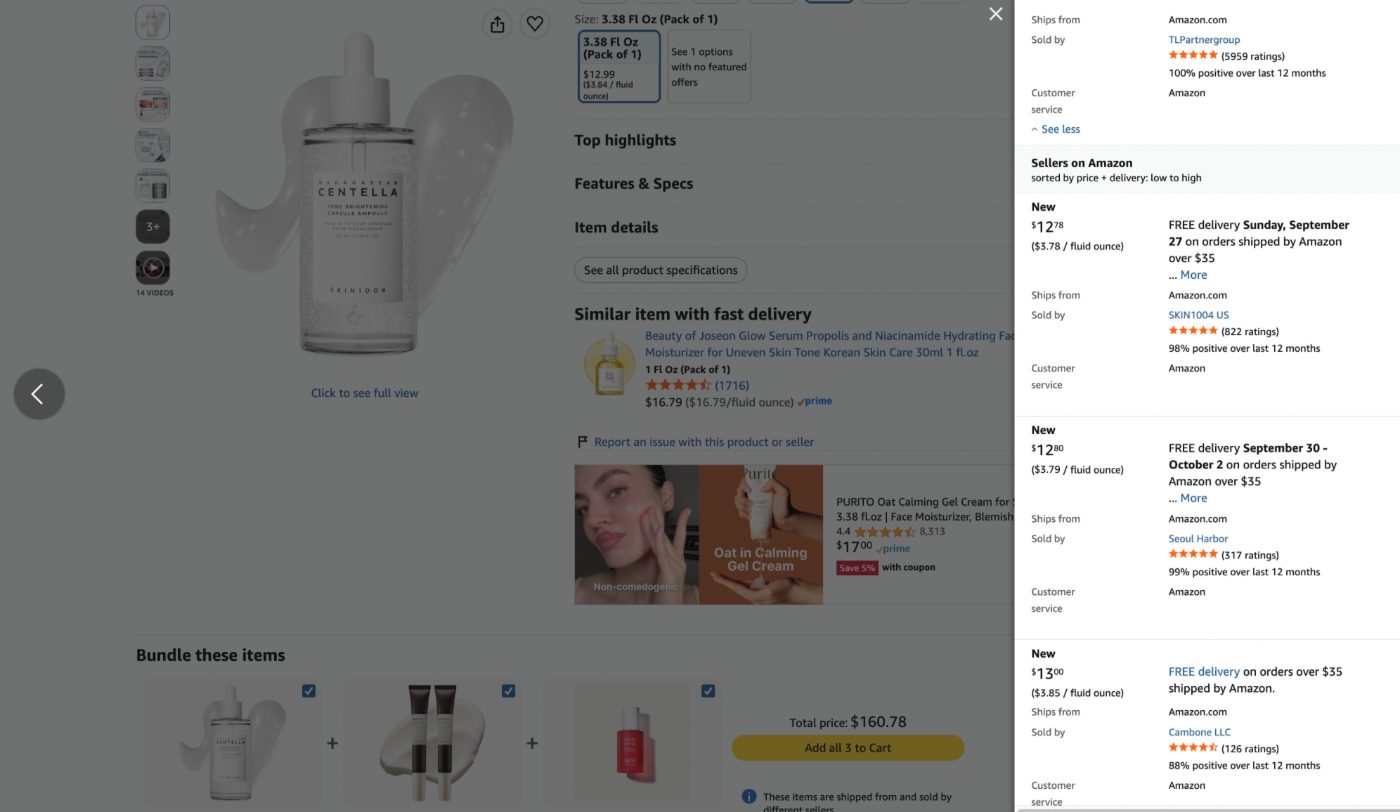
The screenshot shows how one product listing can have several sellers. I recorded this example in September 2026; the default Add to Cart seller may have changed since then. Before buying, check the current Sold by line and the seller ID.
How it works (skip to the next section if you just want the fix)
First off, are the people who end up with fakes buying from some obviously sketchy link? Of course not. They order from a page that's fully connected to the brand's official presence, with a product description written by the brand's own account and thousands or tens of thousands of reviews on it. It looks perfectly official to anyone. And then some people get the real thing and some people get a fake.
So why does the same link give one person the real product and another a fake? It comes down to Amazon's Buy Box system.
Here's an example. Say SKIN1004 lists Product A on Amazon. The listing is fully connected to SKIN1004's official site, with a description SKIN1004 wrote themselves and 20,000 reviews. At first, naturally, when a customer buys it they get SKIN1004's product or their official distributor's.
Then a new third-party seller shows up (the h?~?, f?~? type names). They've picked up Product A very cheaply from somewhere nobody can trace, and they want to move it on Amazon at a low price.
On Amazon, if you can supply the same product cheaper, you can take over the description and the reviews the original seller built up. That's what taking the Buy Box means. (When competition is fierce, it can flip every few hours.) When that happens, a customer buying from that official Amazon page doesn't get the stock SKIN1004 put there, they get the third-party seller's stock. And that product may have been copied and moved cheaply through channels nobody can account for, so the ingredients, the texture, and the real expiration date can all be different.
I personally think this eats away at the trust between a brand and its customers. A brand spends a long time building that bond, and then because of some third party, the customer is let down by the product and ends up let down by the brand.
Not every third-party seller is like this, obviously. Some companies really do get genuine stock cheap through unusual channels. But as a customer, if it's the same price or two dollars apart, I think a lot of people, me included, would rather take the product SKIN1004 officially supplied than take the risk.
Amazon built this structure so sellers compete on price. For two identical spatulas, that makes sense. For something you put on your face, you get the problem above.
The fix
So how do you actually prevent this? You can't block it perfectly, but it's worth doing what you can.
Amazon shows a “Sold by” line, small but there, telling you who the seller is. And you can pick the seller yourself before you buy.
There used to be less point in doing that. For stock from before March 31, 2026, units of the same product were kept in the same warehouse no matter which seller they belonged to. So official distributors' stock and third-party stock were mixed together in circulation.
Fortunately, Amazon recognized the problem: for stock after March 31, 2026, they've said units are stored separately by seller, and an order placed with a given seller ships only that seller's stock. Source: Amazon Seller Forums
(I've also heard cosmetics were always stored separately, but I'm not sure about that.)
Either way, separate storage aside, choosing your seller raises your odds a lot of getting the real thing with a properly managed expiration date. (There are always edge cases, so I'm careful about ever saying 100%.)
That leaves two questions: how do you find and choose the official seller, and how do you know who the official seller is?
For the first one, this post is a good guide: Gentle reminder: be a savvy and discerning shopper
The key part
Question 2 is what's left, and it's a bit tricky.
Some are easy. A seller called BEAUTY OF JOSEON OFFICIAL reads as official to anyone. But SKIN1004 and COSRX both recognize iHerb as an authorized retailer, so at least for those brands you can treat the iHerb seller as a fairly trustworthy source. (Sources: skin1004.com/pages/stores and cosrx.com/pages/stores)
Then there are SKIN1004 NA and SKIN1004 US. Their names sound official, but I have not confirmed whether either Amazon account is currently operated or authorized by SKIN1004. The NA seller profile names CRC COMPANY, a former corporate name of Craver Corporation. That history alone does not establish who operates the Amazon account now. The US seller profile names FORFOREIGNER INC, and I have no brand confirmation for that account either. I therefore leave both unverified. The brand-operated account I have confirmed is SKIN1004 OFFICIAL (seller ID A3QYG3VYJ8I2CZ), although I found no offer from it across the 30 products I reviewed in September 2026. Check current offers before buying.
So: check the Amazon store name, that seller's Amazon seller ID, and finally whether the registered business name lines up, along with the address.
I'd been keeping notes on the relationships I turned up while digging into this, and I went back and forth on how to actually show them. I considered a spreadsheet, but it couldn't hold everything, and having to open it every time seemed like a pain to use. So a friend and I thought about other ways.
That's how I ended up building a very simple site that filters out third-party sellers when you paste an Amazon product link: the official seller check.
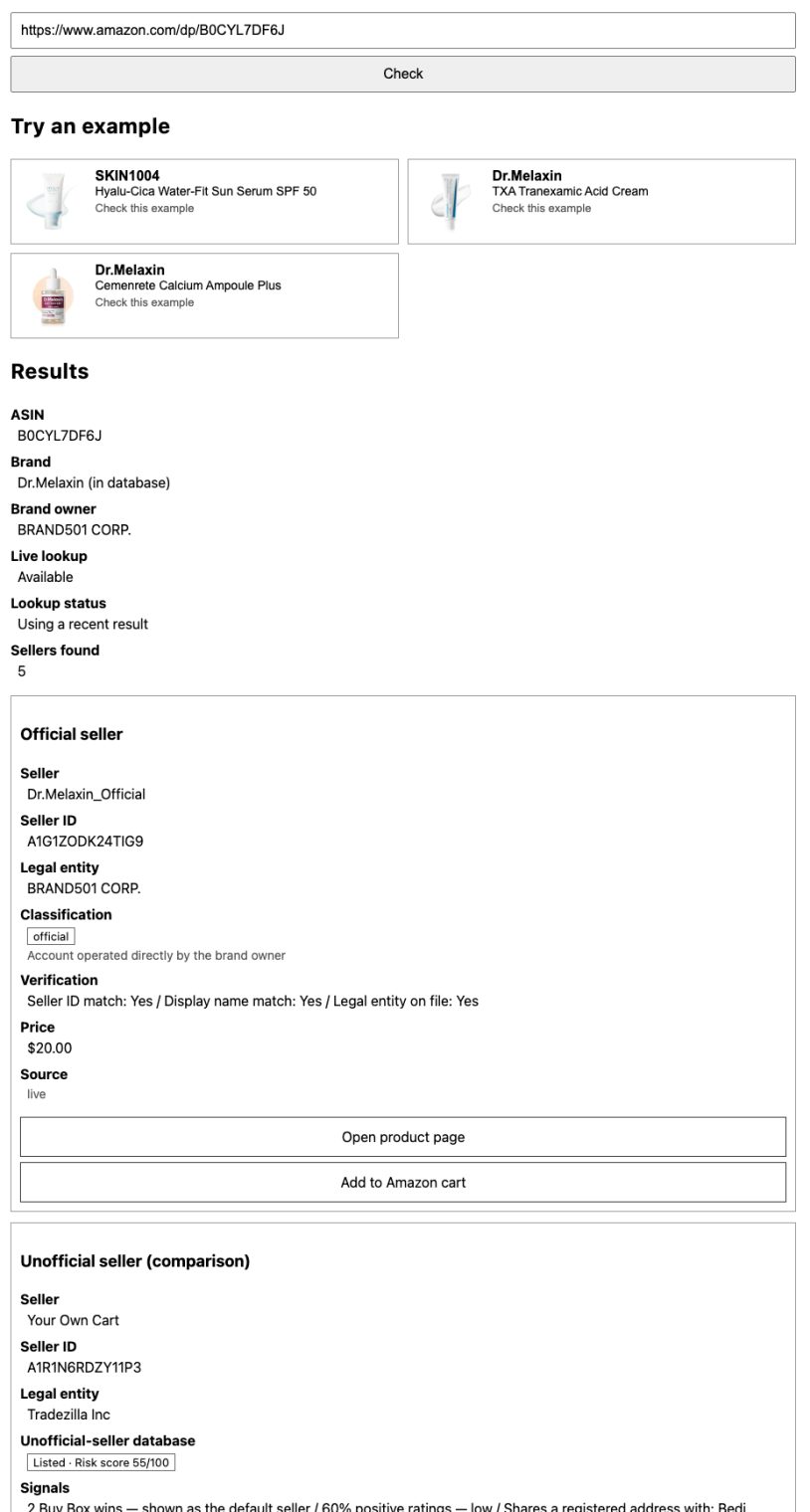
(Full disclosure: these are Amazon affiliate links. Amazon only lets you build the “add to cart from a specific seller” feature with an affiliate tag attached, so that's how it's built. It costs you nothing extra, and it has no effect on which sellers get shown.)
Anyway, the takeaway: look carefully at the seller name, the ID, and the registered business name before you buy on Amazon, and you can avoid ending up with a fake or a product whose expiration date nobody managed.
This turned out really long. My research isn't thorough enough, so there may be things in here that are wrong or off, and I'd appreciate your understanding.
Feel free to leave opinions, your own buying tips, questions, anything, in the comments. Thanks for reading all of this.
Common questions
Why does fake K-beauty show up on official Amazon listings?
The author explains it with Amazon’s Buy Box. A third-party seller can offer the same product cheaper and take over the listing’s description and reviews, so a customer buying from an official-looking page may receive the third-party seller’s stock, which may have moved through channels nobody can account for.
What is the Amazon Buy Box?
It is the seller whose offer is the default behind the Add to Cart button on a listing that has several sellers. When competition is fierce, the author says it can flip every few hours.
How do I check who is selling a product on Amazon?
Look at the “Sold by” line, then check the seller’s store name, their Amazon seller ID and whether the registered business name and address line up. You can also choose the seller yourself before you buy.
Does Amazon keep each seller’s stock separate?
According to the post, units of the same product were kept in the same warehouse regardless of seller for stock before March 31, 2026, and Amazon has said that for stock after that date units are stored separately by seller, citing the Amazon Seller Forums. The author isn’t sure whether cosmetics were always stored separately.
Are all third-party sellers selling fakes?
No. Some companies genuinely get authentic stock cheaply through unusual channels. The author’s point is that at the same price, or a couple of dollars apart, many people would rather take the product the brand officially supplied than take the risk.
Is iHerb an authorized seller for SKIN1004 and COSRX?
The author says both brands recognize iHerb as an authorized retailer on their store pages, so for those brands the iHerb seller can be treated as a fairly trustworthy source.
Keep reading
- Does topical PDRN actually work? Does PDRN work in creams and serums? A Korean doctor explains why topical PDRN struggles to pass the skin barrier and reach the dermis. English translation.
- Korean skincare tips from beauty nerds (TheQoo) Korean skincare tips from a long-pinned TheQoo post: eight points from a Korean beauty nerd on routines, pricey products, ingredients and DIY. Translated.
- Is eye cream worth it? Is eye cream worth it? Korean dermatologist Choi Won-jun explains why most eye creams work like a regular moisturizer, and what to use instead.