HIFU vs RF vs EMS vs Microcurrent: Beauty Device Comparison Chart
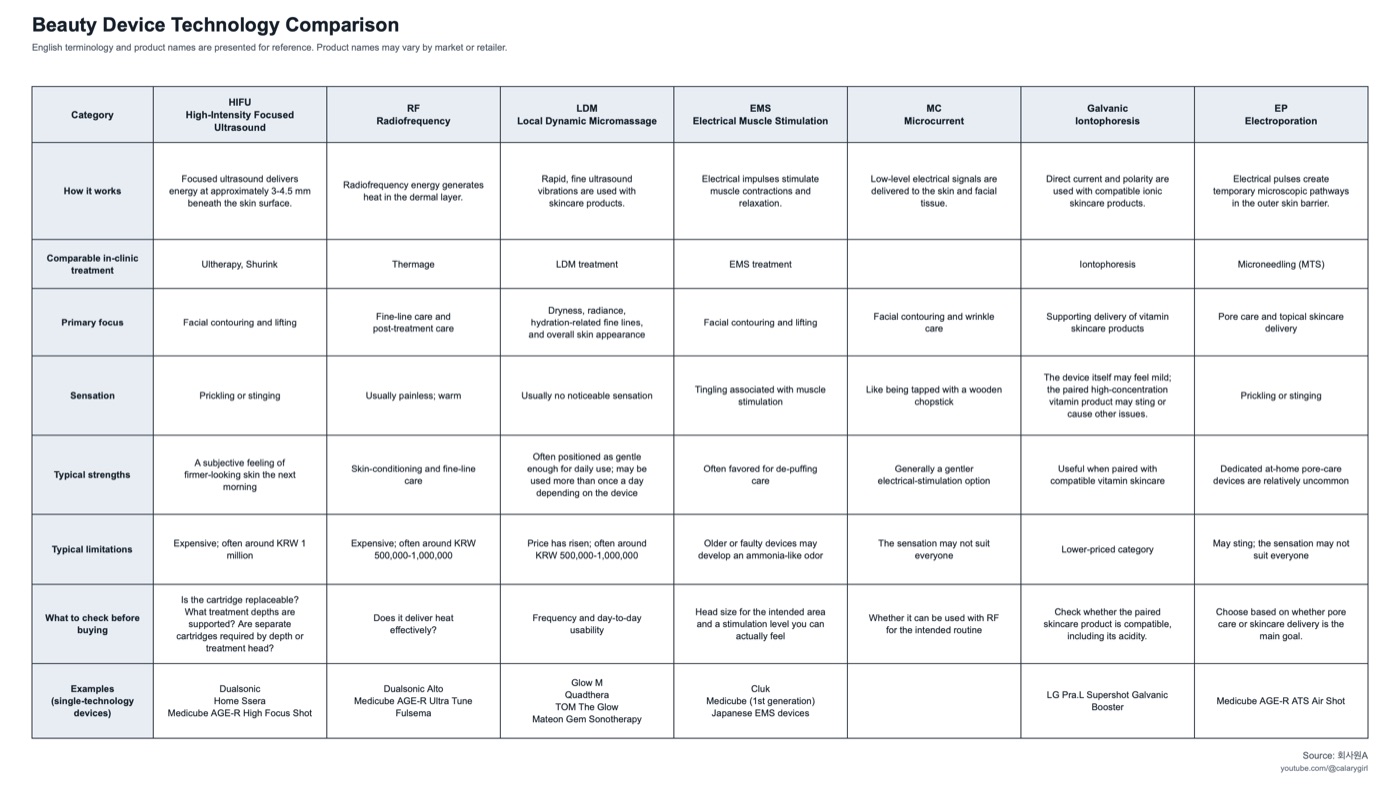
The comparison chart as text
| Category | HIFU High-Intensity Focused Ultrasound | RF Radiofrequency | LDM Local Dynamic Micromassage | EMS Electrical Muscle Stimulation | MC Microcurrent | Galvanic Iontophoresis | EP Electroporation |
|---|---|---|---|---|---|---|---|
| How it works | Focused ultrasound delivers energy at approximately 3–4.5 mm beneath the skin surface. | Radiofrequency energy generates heat in the dermal layer. | Rapid, fine ultrasound vibrations are used with skincare products. | Electrical impulses stimulate muscle contractions and relaxation. | Low-level electrical signals are delivered to the skin and facial tissue. | Direct current and polarity are used with compatible ionic skincare products. | Electrical pulses create temporary microscopic pathways in the outer skin barrier. |
| Comparable in-clinic treatment | Ultherapy, Shurink | Thermage | LDM treatment | EMS treatment | Iontophoresis | Microneedling (MTS) | |
| Primary focus | Facial contouring and lifting | Fine-line care and post-treatment care | Dryness, radiance, hydration-related fine lines, and overall skin appearance | Facial contouring and lifting | Facial contouring and wrinkle care | Supporting delivery of vitamin skincare products | Pore care and topical skincare delivery |
| Sensation | Prickling or stinging | Usually painless; warm | Usually no noticeable sensation | Tingling associated with muscle stimulation | Like being tapped with a wooden chopstick | The device itself may feel mild; the paired high-concentration vitamin product may sting or cause other issues. | Prickling or stinging |
| Typical strengths | A subjective feeling of firmer-looking skin the next morning | Skin-conditioning and fine-line care | Often positioned as gentle enough for daily use; may be used more than once a day depending on the device | Often favored for de-puffing care | Generally a gentler electrical-stimulation option | Useful when paired with compatible vitamin skincare | Dedicated at-home pore-care devices are relatively uncommon |
| Typical limitations | Expensive; often around KRW 1 million | Expensive; often around KRW 500,000–1,000,000 | Price has risen; often around KRW 500,000–1,000,000 | Older or faulty devices may develop an ammonia-like odor | The sensation may not suit everyone | Lower-priced category | May sting; the sensation may not suit everyone |
| What to check before buying | Is the cartridge replaceable? What treatment depths are supported? Are separate cartridges required by depth or treatment head? | Does it deliver heat effectively? | Frequency and day-to-day usability | Head size for the intended area and a stimulation level you can actually feel | Whether it can be used with RF for the intended routine | Check whether the paired skincare product is compatible, including its acidity. | Choose based on whether pore care or skincare delivery is the main goal. |
| Examples (single-technology devices) | Dualsonic, Home Ssera, Medicube AGE-R High Focus Shot | Dualsonic Alto, Medicube AGE-R Ultra Tune, Fulsema | Glow M, Quadthera, TOM The Glow, Mateon Gem Sonotherapy | Cluk, Medicube (1st generation), Japanese EMS devices | LG Pra.L Supershot Galvanic Booster | Medicube AGE-R ATS Air Shot |
Source: 회사원A (youtube.com/@calarygirl). English terminology and product names are presented for reference; product names may vary by market or retailer. See the full breakdown in Part 1, Part 2 and Part 3.
Common questions
What is the difference between HIFU and RF?
According to the chart, HIFU delivers focused ultrasound energy about 3–4.5 mm beneath the skin and is aimed at facial contouring and lifting, while RF generates heat in the dermal layer and is aimed at fine-line care and post-treatment care. The comparable in-clinic treatments are Ultherapy and Shurink for HIFU and Thermage for RF. HIFU can prickle or sting, while RF is usually painless and warm.
What is the difference between EMS and microcurrent?
EMS uses electrical impulses to stimulate muscle contraction and relaxation, with a tingling sensation, and is often favored for de-puffing care. Microcurrent delivers low-level electrical signals to the skin and facial tissue and is generally a gentler option, described as feeling like being tapped with a wooden chopstick.
What does LDM mean in beauty devices?
LDM stands for Local Dynamic Micromassage. It uses rapid, fine ultrasound vibrations with skincare products and focuses on dryness, radiance, hydration-related fine lines and overall skin appearance. It usually has no noticeable sensation, and its price has risen to often around KRW 500,000–1,000,000.
What is electroporation?
Electroporation uses electrical pulses to create temporary microscopic pathways in the outer skin barrier, and is used for pore care and topical skincare delivery. The comparable in-clinic treatment is microneedling (MTS). It may sting, and dedicated at-home pore-care devices are relatively uncommon.
What should I check before buying a HIFU device?
Whether the cartridge is replaceable, what treatment depths are supported, and whether separate cartridges are required by depth or treatment head.
How much do at-home beauty devices cost?
In the chart, HIFU devices are often around KRW 1 million, and RF and LDM devices often around KRW 500,000–1,000,000. Galvanic devices are described as a lower-priced category.
Which devices are examples of each technology?
Single-technology examples listed in the chart: HIFU: Dualsonic, Home Ssera, Medicube AGE-R High Focus Shot. RF: Dualsonic Alto, Medicube AGE-R Ultra Tune, Fulsema. LDM: Glow M, Quadthera, TOM The Glow, Mateon Gem Sonotherapy. EMS: Cluk, Medicube (1st generation), Japanese EMS devices. Galvanic: LG Pra.L Supershot Galvanic Booster. Electroporation: Medicube AGE-R ATS Air Shot.
Keep reading
- Beauty devices, Part 1: HIFU vs RF vs LDM HIFU vs RF vs LDM for your face: a Korean beauty YouTuber who owns 46 at-home devices explains what each does and what to check before buying.
- Beauty devices, Part 2: EMS vs microcurrent Microcurrent vs EMS for the face, plus galvanic and electroporation devices: how they feel and differ, from a Korean YouTuber who tested 46 devices.
- Beauty devices, Part 3: strongest device & LG Pra.L A Korean beauty YouTuber on the LG Pra.L Superform Thermashot Ultimate (RF, microcurrent, EMS, electroporation) and her pick for the strongest at-home device.