“90% Are Using It Wrong”: A Seoul National University Dermatologist on Sunscreen
Should you wear sunscreen indoors? Does a high SPF clog your pores? Mineral or chemical? Dr. Park Kyung-yeol, a dermatologist with 15 years of experience, learned at Seoul National University that moisturizer and sunscreen alone get your skin “99 out of 100.” Yet the advice online contradicts itself, he says, because everyone uses a different standard. Here is how to apply sunscreen properly, according to him.
Original video: https://www.youtube.com/watch?v=NkID5a71kzc
Original title: "90%가 잘못 쓰고 있습니다" 선크림 제대로 바르는 법을 서울대 피부과 전문의가 알려드립니다.
Do You Need Sunscreen Indoors? 01:13–05:59

Honestly, my answer is yes: put it on indoors too. Sunscreen is there to block UV, and UV comes in three types, UVA, UVB and UVC. UVC barely reaches the ground, so what we really guard against is UVB and UVA. UVB has a hard time passing through glass, but UVA comes through windows just fine.
So unless you work in a windowless back room, you want sunscreen. The window seat is usually the good seat, and that sunlight carries UVA. Fluorescent lights and monitor glow you can ignore. But the UV from your lunch walk, your commute and that window adds up to more than you'd think. The only people who can skip it leave before sunrise, take the subway everywhere, sit in a back room with no windows and get home after dark.
Skip it and UV attacks your skin cells, which means more wrinkles, more inflammation, more pigment problems like lentigines and melasma, and worse redness. Basically everything dermatologists warn about shows up. Contact dermatitis from an ingredient is real for some people, but if sunscreen just feels stuffy or annoying, that's not a good enough reason to skip it. I see it on my own face: after about four years at the same window, my left side gets more melasma than my right.
SPF 50 vs SPF 30: Just Buy the Highest SPF 05:59–08:15

A viewer asked whether SPF 30 and 50 really differ, since some videos say a high number suffocates your skin and causes breakouts. I even wrote a paper on this back in residency, and some of what spreads on YouTube frustrates me. I'll do all the studying, so you just hit subscribe and like.
My conclusion is to always buy the strongest SPF. Almost all of us use less than the recommended amount. For the face, the proper dose is two finger segments of your index finger, and hardly anyone squeezes out that much. Most people use one segment at best, which is half.
And half the amount doesn't mean half the SPF. SPF 50 doesn't become 25, it drops to roughly a quarter, about 12 to 13. SPF 30 falls to about 7 or 8. So even with a 50 you end up wearing a very weak sunscreen. Some videos say choose a low SPF if you're mostly indoors and a high one outdoors, but just use the highest, because you'll never apply the full amount anyway.
How Much Sunscreen to Use and How Often to Reapply 08:15–11:05

For ointments, a patch about one hand-span wide takes roughly 0.5 g, and one index-finger segment is about 0.5 g. A face is around one to two spans. Since that's hard to picture, you'll see advice online to use a 500-won coin-sized amount, which is about two finger segments. Add your neck and ears and it doubles, so about four segments.
You've probably heard you should apply it 15 to 20 minutes before going out, or even 30 minutes. The idea is that mineral sunscreen works right away while chemical needs time to spread. Honestly, the evidence for that isn't strong. What matters more is that after two to three hours, sebum, sweat and rubbing wear off a lot of it, so we tell patients to reapply every two to three hours.
Realistically, people who wear makeup can't do that. Touch-up makeup contains UV filters too. A famous female professor at Boramae Hospital once told a patient who wore no sunscreen and no makeup to wear makeup, thick, for exactly that reason. For makeup wearers, touching up during the day is enough.
Mineral vs Chemical Sunscreen: Which One Should You Use? 11:05–14:50
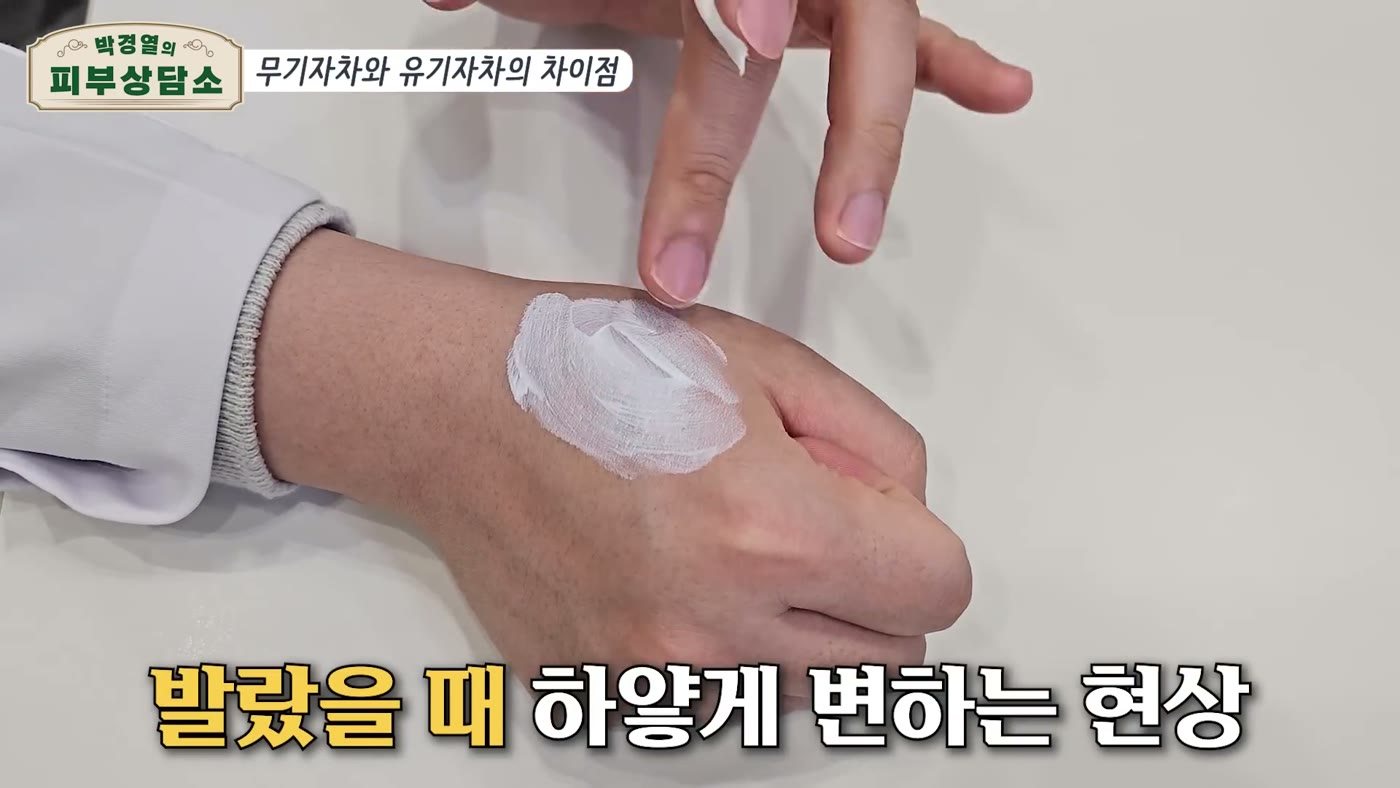
A subscriber wrote in with a severe sunscreen allergy: hives from chemical, bumps from mineral a few days later, and without sunscreen, dark spots coming up on the cheeks. Many of you probably share that worry.
Mineral sunscreen forms a physical film on the skin that reflects UV like a mirror. Chemical sunscreen absorbs UV, turns it into heat and releases it. Mineral is gentle, but its particles are big, so it can clog pores and worsen acne. It also leaves a white cast and spreads a little worse. Chemical spreads beautifully with no white cast, but sensitive skin can get contact dermatitis, with red, itchy, stinging skin around the eyes and cheeks. Because it converts UV to heat, some people also feel warmth at first.
So for very sensitive skin, or skin that reacts to cosmetics, or redness and rosacea, I recommend mineral. For acne or bumps, I recommend chemical because it doesn't block pores. And don't lump acne-prone and sensitive skin together. Acne comes from clogged pores, from excess sebum or trouble with how surface cells turn over. Sensitive skin means a damaged barrier, so irritants get in and cause inflammation. Most sunscreens on the market mix both, while the ones sold in dermatology clinics usually use just one.
Does a High SPF Cause Breakouts? 14:50–16:02

No, that's simply not true. SPF measures how well a product keeps UV from turning your skin red, so more filter naturally means a higher number. But clogged pores come from a large amount of mineral filter, not from the SPF number.
If a brand crams in loads of mineral filter to push SPF up, that product will break you out. If a high SPF comes from chemical filters, it won't clog your pores. So the ratio matters, meaning how much mineral filter is in there. The catch is that most sunscreens are blends and the companies don't tell you the ratio, so you can't really know.
How to Find the Sunscreen That Suits Your Skin 16:02–17:42
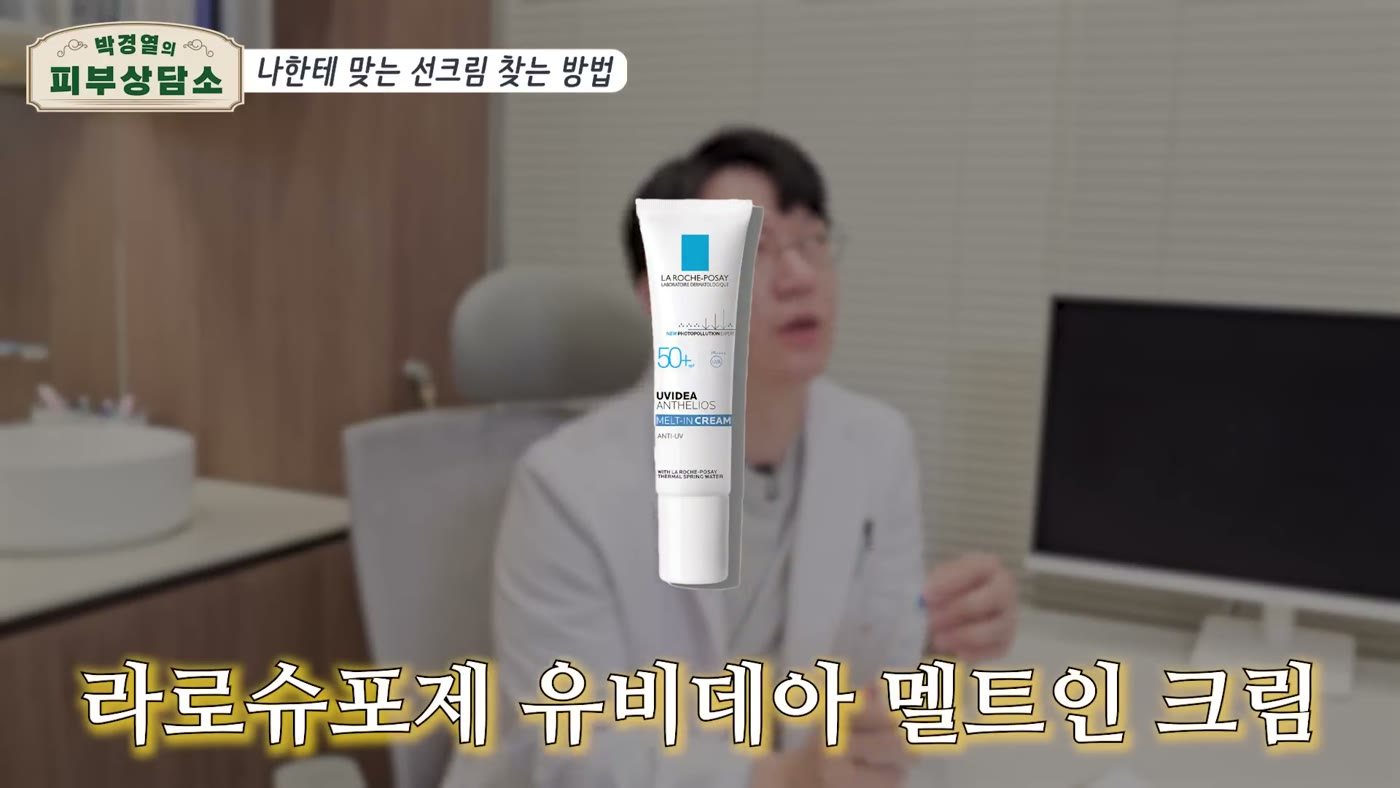
I'm not here to tell you which one is the national must-have. What matters is trying several and finding the one that suits you. Testers at Olive Young or Daiso are a good start. Try each one, see whether it causes trouble, and when something works, use it for a good while.
I've used almost the same sunscreen for 10 years. It never gave me trouble and its SPF and PA are high, so why switch? Patients often come in saying their face turned red after changing products, so my advice is: if it works, don't change it. I use La Roche-Posay's UVIDEA Melt-in Cream. It's not dramatically better than the others, it just never caused me problems. It's SPF 50 and PA++++, one of the strongest on the market. Go for the strongest, then keep using whichever one gives you no trouble.
What SPF and PA Actually Mean 17:42–19:03
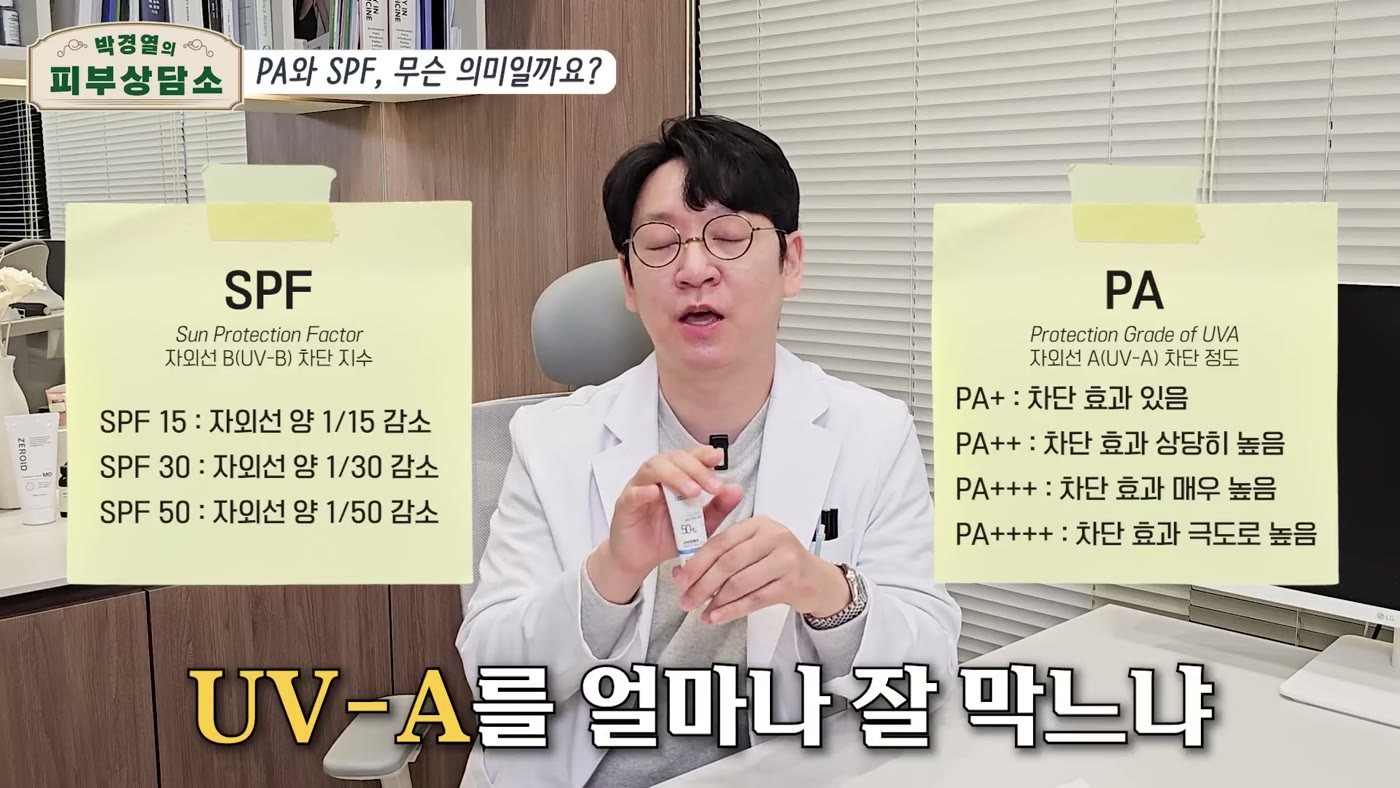
Earlier I said there are different types of UV. SPF tells you how well a sunscreen blocks UVB, and PA tells you how well it blocks UVA. In Korea, SPF can be labeled up to 50 and PA up to four pluses, so SPF 50 with PA++++ is the strongest you can get. In the US you can find SPF 100, but Korea doesn't allow labeling beyond 50, and the rules differ by country.
Is it okay to bring back an SPF 100 from a trip? I think so. You're buying souvenirs anyway, so give it a try. But again, if there's no need to switch, don't. Most of the skin trouble I see comes from people changing a product that was working fine.
Takeaway 21:07–21:50

Here's the short version. Number one, find the sunscreen that suits you, and try several before you decide. If your skin is sensitive, try mineral first. And choose the highest SPF you can. People keep asking how to apply it in practice. I know your worries, but this video got too long, so that's coming in a part 2.
Common questions
Do you need sunscreen indoors?
According to Dr. Park, yes, unless you spend the whole day in a windowless room. UVB barely passes through glass, but UVA comes through windows, so the light near a window still carries it. He says fluorescent lights and monitors can be ignored.
How much sunscreen should you use on your face?
Dr. Park says about two segments of your index finger, roughly a 500-won coin. For face, neck and ears together, he says to use about four segments.
Should you always choose the highest SPF?
He says yes. Most people apply about half the recommended amount, and he says halving the amount drops SPF 50 to about 12 to 13 and SPF 30 to about 7 or 8, so a higher number leaves a safety margin.
Does a high SPF cause breakouts?
Not according to Dr. Park. He says SPF measures UV protection, and clogged pores come from a large amount of mineral filter, not from the SPF number. Brands rarely disclose the mineral and chemical ratio.
Mineral or chemical sunscreen for sensitive skin?
He recommends mineral for sensitive, easily irritated skin or redness, since chemical filters can cause contact dermatitis or a warm feeling. For acne-prone skin he recommends chemical, because mineral particles can clog pores.
Keep reading
- Thermage vs Ultherapy Thermage vs Ultherapy explained by a Korean dermatologist: depth, who each suits, hollow cheeks, burns, genuine tips and whether either really works.
- What really fixes dehydrated skin Dehydrated skin explained: Jamti says the cause is barrier damage, not missing inner moisture, and why barrier cream beats low-molecular hyaluronic acid.
- Why fakes show up on official Amazon listings Fake K-beauty on Amazon usually comes from third-party sellers taking the Buy Box on a real listing. Here's how it happens and how to check the seller first.